nolankido.comPractical AI · A life beyond the screen

Nolan Kido / Creative Work

Creative Work

Nolan Kido's creative work: NolanPoker videos, poker comics, and AI-assisted writing. Read a writing example and use the free creative brief.

Make an idea connect.

I work with writing, design, and visual storytelling as ways of inviting someone into an idea. I am interested in the choices behind them: what to include, what to leave out, and where to give the reader room.

Start with something you can see: a first-person poker video, an illustrated explanation, an original incremental game teaching demo, a tool for checking a book series, or a creative-rights prototype. Then use a small planning sheet, follow a making guide, or read about the choices behind the work.

Books by Nolan Kido

Two book-length projects connect the subjects I write about here: using AI for practical work and learning to reason through poker decisions. Each has free related material on this site.

Open the Books by Nolan Kido catalog to compare the subjects and try free companion exercises.

Retailer URLs, ISBNs, edition formats, and release dates are not listed until their public records can be checked. The book descriptions and free companion resources are not substitutes for verified storefront listings.

Pictures, stories, and the details that hold them together.

Explore a first-person poker video, illustrated explanations, a playable game-design teaching demo, and documented projects about manuscripts and creator rights. Watch a story, try a rule set, or inspect an example and its sources.

First-person video / NolanPoker

Portland Meadows: From 6.5 Big Blinds to a Trophy

My first-person account follows a short-stack recovery and a four-way deal at Portland Meadows. The written companion separates the narrated hands, chip calculations, and questions still open.

The companion draws on archived narration; the current video’s exact scene timing has not been independently checked.

Making your own piece? Explore the proposed hand-to-vlog workflow for separating recorded action, recollection, and later analysis.

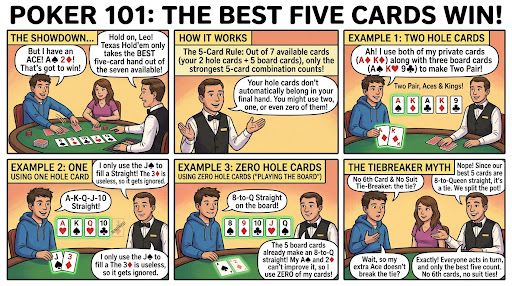
Six comic panels illustrate choosing a five-card poker hand from the board and hole cards.

Published comic ·

The best five cards win

A visual explanation of a deceptively small rule: a Hold’em hand uses the best five available cards. The companion text works through using two, one, or no hole cards and explains why an unused sixth card cannot break a tie.

AI-generated artwork with readable card examples and rules notes.

Read the comic and explanation
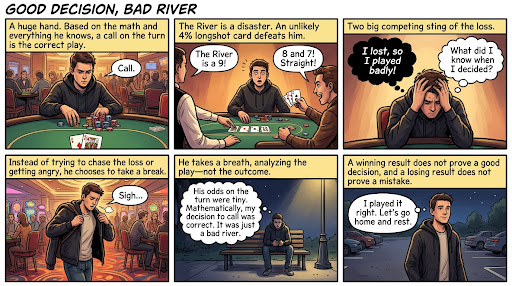
A six-panel comic follows a poker player taking a break and reviewing his reasoning after an unlucky river.

Published comic ·

Good decision, bad river

A short illustrated story about disappointment and learning. The player steps away from the result long enough to examine what he knew when he made the decision. The text companion keeps the lesson accessible beyond the image.

Fictional story and AI-generated artwork, with notes on decision quality.

Read the comic and text version
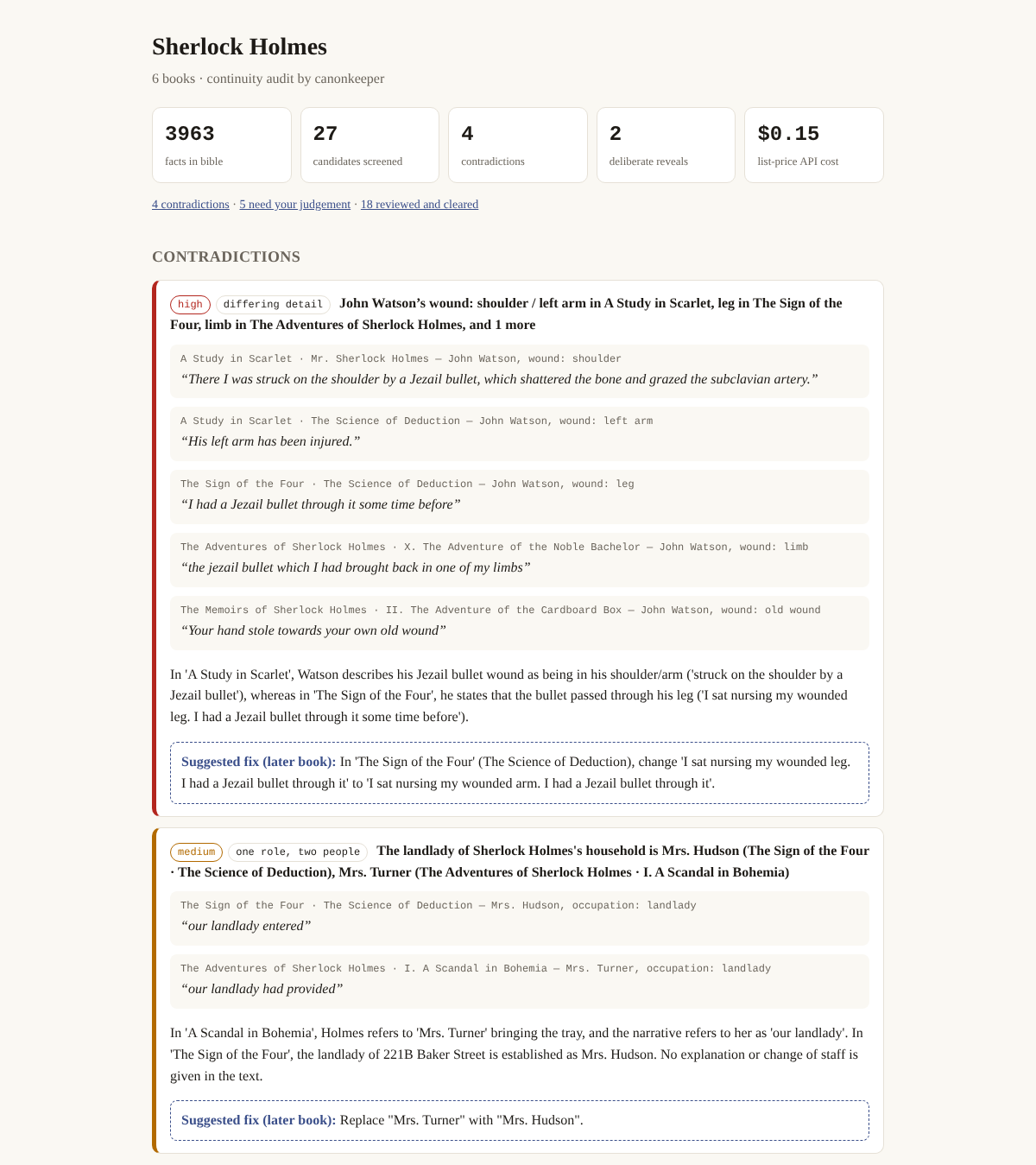
Preflight's Sherlock Holmes report pairs passages about Watson's wound and the landlady's name for review.

AI for writing / Documented project

Checking a book series for continuity errors with AI.

Preflight, built on canonKeeper, collects source passages and flags possible disagreements across books. The case follows a Sherlock Holmes audit, including useful findings, incorrect flags, and missed details.

Actual project output. Authors and editors still decide what the passages mean. A free review log helps separate supported errors from explained changes and missing evidence.

Review a flagged passage
Stylized harbor scene with rain, water and distant lights, a fictional image from the RightsReceipt test.

Creator rights / Public hackathon prototype

Who gets to approve an AI-assisted image license?

RightsReceipt explores the often-missing terms between a buyer's request and permission to use an image. The submitted project includes public source, a local trained-model diagnostic, and scripted transaction tests.

Fictional artwork and parties. Real model inference is separate from the simulated PayPal payment responses; no real license was issued.

Read the project and its evidence

Game design / Original playable teaching demo

Can an incremental game's first minute teach a meaningful choice?

Collect sparks, buy upgrades that improve tapping or add passive production, and see how the costs change. The guide publishes the exact rules, a reproducible run, and a blank playtest sheet. A companion upgrade payback calculator compares the two purchases with transparent break-even math. Both are browser-local teaching material, not released private games or claims about real players.

Play the demo and inspect the rules

For the full illustrated collection, explore all six poker comics. For another everyday creation, see Dinner on Time, an AI-assisted cooking-schedule simulation. See the public project portfolio for creative work alongside software cases and source checks.

Creative brief: give your idea a manageable shape.

The blank brief asks who the piece is for, what belongs in it, and what would make it ready enough to share. Use it for a short article, a video, a visual story, or another small piece. Skip the prompts that do not help.

The smallest useful version: name the person, name the idea, and choose the next action. The rest is there when you need it.

Worked example / AI-assisted fiction

From a brief to a short scene

A sample plan and a fictional scene show one way to use the prompts. The people, setting and dialogue are invented.

Example scene: The spare chair

Mara arrived late for the reading. Every chair was taken except one with a coat folded over the seat.

She stopped beside the door and checked the program again, as if the room number might have changed.

A man by the window lifted the coat into his lap.

“This one’s free.”

She crossed the room.

“Have you been here before?” she asked.

He shook his head and opened his program between them.

They found the first item together.

Read the completed example brief
Reader or viewer
Someone with a minute to read. The scene should make sense without knowing the characters’ histories.
One idea
Show welcome through a small action.
Smallest useful form
One scene under 100 words: two people, one room and one gesture. Their backstories can wait.
Material and permission
Use invented characters, a setting and dialogue. Include no real person’s story, photograph or quoted material.
Three beats
Opening: a newcomer hesitates at the door. Middle: another person clears a chair. Ending: they look at the program together.
Optional AI assistance
Possible help: suggest two openings or flag sentences that explain what the action already shows. The writer chooses the scene, tone and final words.
Ready enough to share
The action is clear, the scene stays under 100 words, and the fiction label travels with it. An illustration can wait.
Next action
Write the scene, starting at the doorway.

Try the same prompts with your own idea. Choose one reader, one small change and one next action.

Blank template / Plain text

One small creative piece

Reader → idea → material → three beats → finish line.

Includes a permission check and an optional place to define AI assistance. It does not generate a story or collect your answers.

Download the creative brief (.txt)
Read or copy the complete blank brief
ONE SMALL CREATIVE PIECE
A blank planning sheet from Nolan Kido
https://nolankido.com/creative/#creative-brief

Use only the prompts that help. Complete your copy privately.
This is a thinking aid, not a scoring system or a publication checklist.

READER OR VIEWER
Who is this for? What do they already know?

ONE IDEA
What should they understand, notice, or feel?

SMALLEST USEFUL FORM
A short note, a single scene, a few pictures, or another small format:
What belongs in this version? What can wait?

MATERIAL AND PERMISSION
What facts, observations, or source material can I support?
What is uncertain or remembered rather than recorded?
Whose words, image, or story require permission before sharing?
Keep private details and other people's personal material out of public copies.

THREE BEATS
Opening: give the person a reason to care.
Middle: show the detail, change, or example that matters.
Ending: leave them with one clear thought or next step.

OPTIONAL AI ASSISTANCE
What limited help would be useful: organizing, alternatives, or a clarity check?
What must remain in my voice or under my control?
Do not upload private or restricted material without authorization.
Check any suggested facts, quotations, or claims against the source.

READY ENOUGH TO SHARE
What would let the intended person follow this piece?
What factual, permission, or accessibility questions still need resolving?
What is one optional improvement I can leave for another version?

NEXT ACTION
One small action I can take, or a reason to set this aside:

For a paper copy, use your browser’s Print command or Save as PDF. The entire blank brief prints even while this preview is closed. Complete your copy privately.

No account is needed. Open the text file in your own notes or text editor and keep the completed copy private. This page has no answer form. Using a cloud notes app or AI service is a separate sharing decision.

This is an AI-assisted planning aid, not a report of a completed personal project. A brief cannot establish permission, verify a fact, or guarantee that a piece will connect.
Choose the kind of piece.

Four practical routes through material already on the site. These are approaches to try, not a portfolio of completed personal projects.

Writing / A first version

Turn a rough idea into something you can share.

Choose a reader, a small scope, and a finish line. Use optional AI assistance without letting it replace the idea you wanted to express.

Work toward: one small version, rather than a growing list of possibilities.

Visual storytelling / A poker-specific guide

From hand note to poker vlog

Follow a poker-specific workflow from recorded action to narration, graphics, and a companion page. Separate what happened from later interpretation.

Work toward: a coherent explanation built from supportable facts. This is a guide, not a published vlog episode.

Personal stories / Someone's voice

Preserve a family story without losing the person's voice.

Start with permission, listen to the speaker, and let them review what you keep. The technology should serve the story.

Work toward: a version the speaker has had a chance to review, not a polished replacement for their voice.

For a broader view, see the resource starting points. For materials and tools, explore free books, art, and creative resources or tools for making things.

The choices behind the work.

Making things & making room

Finishing is a decision.

Distinguish a necessary repair from another possible improvement, define done, and leave room for the rest of the day.

For related ideas across the site, browse the writing. When AI would help with a defined part of the work, build a task brief before delegating it.