Comic 04 · Published
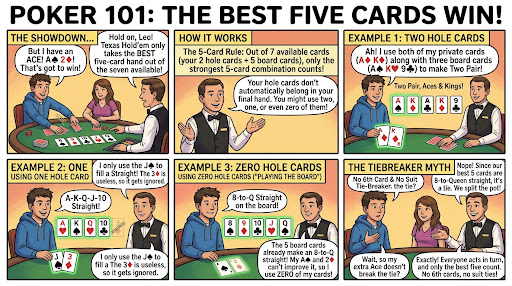
Two hole cards, one hole card, or none: your best five-card hand decides a Hold’em showdown. A sixth card never breaks a tie.
The comic in words
The showdown
A player expects an ace in their hand to settle the result. The dealer slows them down: first identify the best five cards available to each player still in the hand.
How it works
Your private cards do not have to appear in your final hand. Select whichever five-card combination is strongest, whether it uses both hole cards, just one, or the entire board.
Example 1: two hole cards
You hold A♥ K♥. The board is A♣ K♠ 9♣ 5♦ 2♠. Your best hand is A♥ A♣ K♥ K♠ 9♣: two pair, aces and kings, with a nine kicker. Both hole cards contribute.
Example 2: one hole card
You hold J♠ 3♣. The board is A♣ K♦ Q♥ 10♠ 2♦. Your best hand is A♣ K♦ Q♥ J♠ 10♠: an ace-high straight. Only your jack contributes; the three is outside your best five.
Example 3: zero hole cards
You hold 2♦ 3♣. The board is 8♣ 7♦ 6♥ 5♠ 4♣. Your best hand is the board’s eight-high straight. Neither hole card improves it. An opponent holding a nine could make a nine-high straight and beat you.
The tiebreaker myth
On that same 8♣ 7♦ 6♥ 5♠ 4♣ board, A♥ K♥ and Q♠ J♦ both play the eight-high straight. The ace does not help because it is outside the best five. If these are the only two players contesting the pot, they split it.
Does the kicker count?
A kicker matters when it belongs to the best five-card hand. With a pair, compare the pair first, then the three side cards in order. With a straight, all five places are already occupied: compare the highest card in each straight. There is no extra kicker.
Try more examples in Which hand wins? and Reading the board.
Rules reference: PokerStars’ Texas Hold’em rules.
Published by Nolan Kido. Artwork generated with Google Gemini; explanatory text prepared with AI assistance. The written deals are illustrative examples, not recorded hands.