I am learning the game
Follow Poker Foundations for small lessons and practice. Keep the complete Hold’em guide nearby as an optional reference.
Nolan Kido / Poker
New to poker? Learn no-limit Texas hold’em with a free beginner course, worked hands and small practice tasks. Already playing? Find the explanation or preparation your next decision needs.
Free to use, with no signup. A deck, counters or paper is enough to begin.
Here for my tournament stories? Browse the public videos and written companions, or visit NolanPoker on YouTube.
Related book: How to Play No-Limit Texas Hold’em. Start with the free lessons below, then read the book overview.
Looking up something specific? Search 75 guides and 146 outside sources, or browse by topic.
No-limit Texas hold’em / For beginners
Learn to follow a hand and explain your next decision. Begin with the cards, then connect the action, the board and the reasons behind a bet.
Your route through the course
Name your legal actions, count an additional call and build the best five cards.
Describe position and earlier action before judging two private cards.
Name a made hand and a draw separately, then read the action.
Rebuild the best five after each new card and distinguish a call price from a reason to call.
Separate known cards, possible opposing hands and assumptions about their frequency.
Say which worse hands might call or better hands might fold, and compare betting with checking.
Each lesson has a short first pass, a question to explain and a practice situation with a repair link. The card builder, guided hand and betting rehearsal are there when you need them.
Know the rules already? Try the checkpoint and use its repair links to choose what to revisit.
In development / Optional
I'm exploring a future Poker School course with original narrated hand walkthroughs, connected practice and a clearer path from the first cards to following a live game. The free Poker Foundations lessons are not moving behind a paywall.
The course is not available to purchase. Launch date, pricing and curriculum are not confirmed.
Choose the task that fits today. The free course has a suggested order; the practice, live-play and reference routes can be used on their own.
Follow Poker Foundations for small lessons and practice. Keep the complete Hold’em guide nearby as an optional reference.
Work through a decision with its context, compare a choice with its result and identify what you need to check.
Plan the setting, procedures and whole cost before deciding whether to play.
Connect probability, ranges and tournament value, then examine the models behind the claims.
Short-stacked in a tournament? Choose a worked guide by effective stack: 3–5 BB: shoves and calls, 6–10 BB: opens and rejams, or 10–20 BB: context and ICM. Near the money with ten blinds? Compare chip value and payout value in a worked bubble call. For six more after-play questions, try the 10 BB Playbook's answered exercises. To evaluate a chart or video before adopting its advice, check whether a ten-blind solver recommendation actually fits the hand. None is a universal shove chart.
Use these as references alongside the free course or for deeper study. You can start learning without reading a long essay first. Times below estimate reading, before practice or note-taking.
Complete introduction
A complete reference for rules, a counted hand, prices and ranges. Use alongside the free course or read in sections.
About 49 min read
Live cash and tournament decisions
Several callers, different effective stacks and a counted live hand. Cash and tournament assumptions stay explicit.
About 16 min read
10–20 BB tournament study
Available actions, antes and chip value versus prize value. Includes a checked ICM example and a review sheet.
About 16 min read
Advanced essay
Probability, Bayesian ranges, expected value and variance. Read after the basics; calculations can be reproduced.
About 50 min read
Browse every on-site guide or choose a worksheet or practice exercise.
Each topic connects on-site explanations with outside sources. Choose a subject first, then choose the depth and format you need.
Search the guide text and build a downloadable study list. Use three study calculators with their assumptions visible.
Start with one beginner skill and an explained example. After the foundations, pause before the result in One river. Two different stories. Or explore all three Decision Labs. Every case is explicitly fictional.
Open the Study Desk or download the hand-review sheet. No account, email gate or submission of your answers.
Heading to Lincoln, California? Plan a first poker visit to Thunder Valley.
Use the live tournament field guide, budget the full trip, and print or copy the checklists.
Use study tools and exercises away from play. Always check the rules of the game or platform.
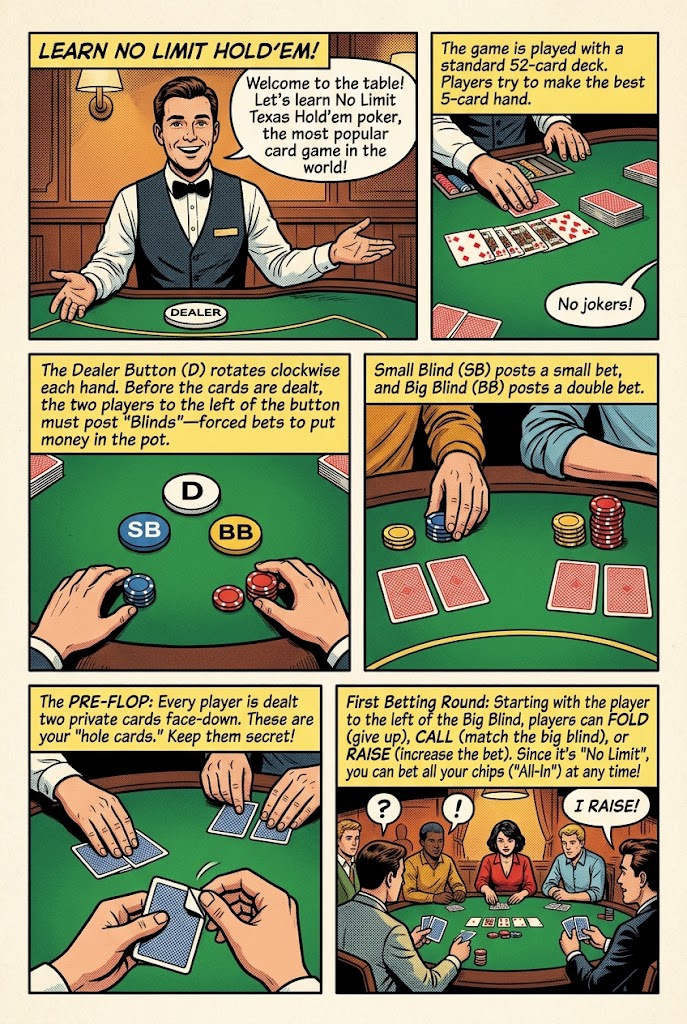
Comic 01
A visual welcome to the table, with a readable text version and a few important rules notes. The first in a growing collection of poker comics.
Continue the series with Comic 02: Poker hand rankings, then follow the action in Comic 03: One hand, four streets. Learn what counts at showdown in Comic 04: The best five cards win, then discover the value of position in Comic 05: Why acting last helps. Explore bad beats and decision quality in Comic 06: Good decision, bad river.
Six public video links. Three written companions distinguish documented hand accounts from current-video details that have not been independently checked.
These edited first-person videos are not official results. Titles open on YouTube. How the links were checked.
South Point / NolanPoker
 I Went for $1.50 Hot Dogs... Then Entered a $120 Poker Tournament
A public NolanPoker video about a South Point visit. The title is confirmed by public YouTube metadata, but the footage, hand details and chapter times have not been independently reviewed here. This upload is not evidence for the separately listed Lucky 300 result.
Portland Meadows / Deepstack
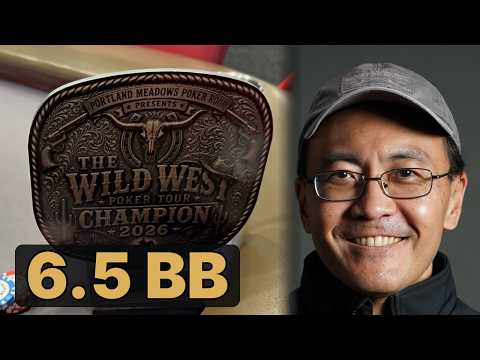 I Had 6.5 Big Blinds... Then Won a Trophy
A short-stack comeback and a four-way deal, as narrated in the public episode. Read the source-checked companion and its 6-4 decision and pocket-sevens decision. Match these hands to study guides. For separate practice, try nine fictional short-stack questions, not a grade for either narrated shove.
Portland Meadows / Evening Stand Off
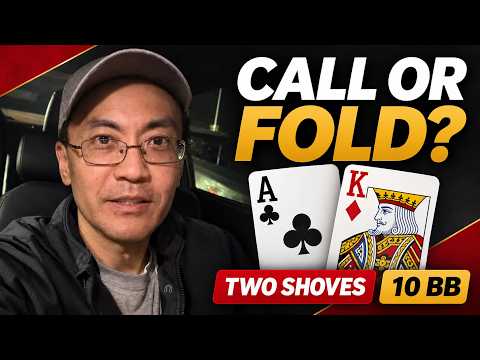 I Had A-K With 10 Big Blinds. Then TWO Players Shoved.
A separate $200 Stand Off event from that evening. Read the full archived-source written companion, or review the two decisions briefly here. Neither text claims frame-by-frame verification of the current YouTube cut. Compare this hand with a study guide, or try the A-K second-decision question from the archived-source companion.
Portland Meadows / Episode 3
 I Won Yesterday. Today I Had One Bullet. | Portland Meadows Poker
A later first-person tournament upload. Its current public title was checked on November 13, 2026, but no source-checked hand companion, independently verified scene claims or chapter timecodes are published here yet.
Portland Meadows / Day 4
 I Busted... Then Flipped Into a Final Table | Portland Meadows
A later first-person tournament upload. Its current public title was checked on November 13, 2026; the linked video has not been independently audited against a final source packet for this website.
WSOP Circuit / Reserve Day 1
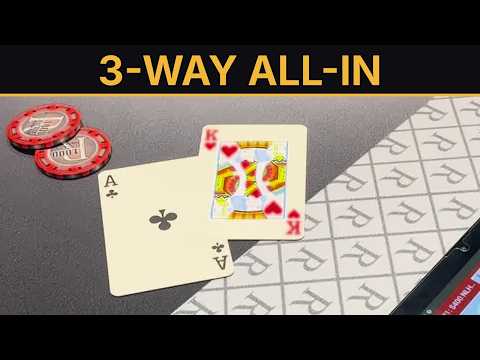 My Ace-King Reshove in a 3-Way All-In | WSOP Circuit
A narrated short-stack comeback and three-way A-K pot. Read the archived-source Reserve Day 1 companion, or go directly to why about ten uncalled big blinds came back, then try the three after-play questions. The independently listed finish is 63rd; the current YouTube title and thumbnail were checked November 18, but the current cut's spoken hands and graphics have not been independently audited.
External video availability can change. These uploads are not official tournament result records, poker-coaching credentials, or independently verified strategy solutions.
Read Nolan Kido’s tournament player profile and verified results, or see how NolanPoker connects to my practical AI work through a source-checked editorial example.
Read the source-limited hand account first, then use a separate worked guide to explore a similar stack depth. These guides do not solve these exact tournament hands.
For smaller stacks, read the 3–5 BB guide. None of these four documented hands is a confirmed 3–5 BB hand. An outcome or retrospective read does not prove the best action.
These YouTube uploads are edited first-person accounts. Independent tournament listings are linked in my player record. The Deepstack, Stand Off and Reserve Day 1 videos now have written companions with different archived-source limits; none certifies the live video's current chapter offsets. All six video titles, channel names and thumbnail URLs were checked against YouTube's public oEmbed metadata on November 13, 2026. The Reserve Day 1 title and local thumbnail snapshot were checked again and updated November 18, 2026, because the public video packaging changed; the other local thumbnails remain snapshots from the earlier check, not live YouTube embeds. The two later Portland Meadows links were originally supplied by me, and their current cuts, hand claims and chapter times have not been independently verified here. The South Point video title and channel identity were also checked against YouTube's public metadata on November 12, 2026; its footage and hand details have not been independently audited for this website. A thumbnail is not independent evidence of any result. The Reserve companion uses an archived v8 production packet and public WSOP, GPI and Hendon Mob results, not a freshly audited video cut.
November 20 public listing check: The six featured YouTube watch-page titles still matched the linked titles, and all three written-companion pages were retrievable. Review the dated six-video title and link audit (.json). This pass did not refresh thumbnail files, independently recheck channel bylines, play the videos or approve current-cut chapter offsets. Only the Deepstack companion has newer viewer-visible transcript starting points, which are not frame-verified video chapter markers.
For future tournament uploads, subscribe on the NolanPoker YouTube channel. The written companions and independent results remain linked here.
In the recorded 12-round Stand Off account, I begin with about ten big blinds and A-K on the button. This review uses my archived v9 editing script and source-verification notes, which draw on my recorded narration and a camera-clock image. The public Episode 2 upload exists, but I have not independently checked that its current scene timing, graphics or every spoken word still matches the archived v9 package.
Tournament setting, as reported in the source packet: $200 entry, 30,000 starting chips, and a planned ICM-based payout to players surviving the end of round 12. A camera-clock reference in that packet places the main hand around round 10, with 17 of 78 entries remaining, at 3,000/6,000 blinds and a 6,000 big blind ante. These are source-packet claims, not an independently confirmed current tournament structure or calendar date.
What can be checked arithmetically: approximately 61,000 less 15,000 is about 46,000 chips; 15,000 to call less the big blind's posted 6,000 is 9,000 more; 61,000 at a 6,000 big blind is roughly 10.2 BB before the first call. The 6,000 big blind ante is a separate contribution, not another six thousand already covering the raise. These calculations do not reveal the players' actual ranges or determine whether the 46,000 call was correct.
Inspect the bounded record: download the archived-source A-K ledger (.json) and the offline consistency checker (.py). Both concern the source record, not the current video export. The structured record deliberately marks full boards, opponent suits, ICM results, exact payouts, verified current-cut chapters and human video sign-off as unavailable.
To check the ledger locally, save both files into the same folder and run py -3 portland-meadows-standoff-ak-gate.py --check portland-meadows-standoff-ak-source-ledger.json. Run py -3 portland-meadows-standoff-ak-gate.py --self-test to test six deliberately altered examples. Use python3 instead of py -3 on macOS or Linux. The checker uses only Python's standard library and neither uploads the record nor runs an AI model.
This is a short source review and reusable method for distinguishing an initial plan from a later decision. The longer Stand Off companion supplies the full narrative and source limits, without claiming the current video graphics or timecodes have passed review. The original production packet remains private. The separate Episode 1 companion documents the earlier Deepstack event. For editing standards, see From Hand Notes to a Poker Vlog.
I play live tournament poker as well as write about poker study and decision-making. Independent tournament records document results in no-limit hold'em and pot-limit Omaha. The point of this section is to distinguish the public record from the analysis and stories I may publish later.
For a broader public record, see the official WSOP player profile and Global Poker Index listing. Reported cashes are gross event payouts, not net profit. Public listings do not account for every entry, reentry, travel cost, staking arrangement, or session without a cash.
My approach to reviewing a poker hand explains why I separate the information available during play from what I know after the result.
Published video companion
Watch a real short-stack comeback, 6-4 versus A-K, pocket sevens versus A-T, and a four-way deal. The companion separates the $2,900 reported payment from the advertised $5,100 first-place prize.
Companion published November 2, 2026. The video opens on YouTube; other public uploads have no source-checked written companion on this site yet.
Real hand records: 6-4 offsuit near the bubble · pocket sevens four-handed.
Watching a hand for the first time? Use the viewer guide. See one explanation before and after.
Solver-style advice depends on the model and its inputs. In a live tournament, exact ranges, opponent incentives, payout effects, and even some remembered actions may be uncertain. Winning or losing a pot cannot settle whether the decision was good.
For the underlying records, read the Portland Meadows six-four offsuit hand and my hand-review framework. I discuss the broader tension in When to Trust the AI vs. When to Trust Human Instinct.
For a concrete creative-production example, see how an AI-assisted caption draft is checked against this same public hand record. It separates reported action, recomputable stack math, proposed graphics and the human review that has not yet happened for the current video cut.
The same evidence-first method informs my practical AI work in technology, including checking software even after automated tests pass. These tournament accounts do not claim complete, independently verified GTO or ICM solutions.
The directory is growing, not complete. See what it covers and what is still missing. Outside sources carry access labels, review dates and limitations. Fictional exercises and personal accounts stay clearly separated.
Read the resource review policy or inspect the recorded review methods and dates. Gambling-support resources are always available without searching.
Send a question, correction or resource suggestion. Include the page or topic, but leave other players' private information out. Follow the Poker RSS feed for new published pages.